
Commercial Real Estate Investment Calculator
Property Details
Investment Analysis
Income & Expenses
Lender Feasibility Check
DSCR (Debt Service Coverage Ratio): --
Enter values to see if lenders will approve this deal.
Buying a house is one thing. Buying a building that houses an office, a grocery store, or a warehouse is another beast entirely. If you’ve ever looked at a "For Sale" sign on a strip mall and wondered how the math works behind those massive transactions, you’re not alone. Commercial real estate investing is the practice of purchasing income-generating properties like offices, retail spaces, industrial warehouses, and multifamily apartments to generate profit through rent and appreciation. It’s less about finding a cozy home and more about running a business where the asset happens to be bricks and mortar.
In 2026, the landscape has shifted again. With interest rates stabilizing after the volatile years of the early 2020s, investors are looking harder at cash flow rather than just price appreciation. You aren’t just buying square footage; you are buying a revenue stream. But how do you actually pull it off? Let’s break down the mechanics, the money, and the mindset required to succeed in this high-stakes game.
The Core Difference: It’s All About the Lease
The first thing you need to grasp is that commercial real estate (CRE) operates on completely different rules than residential real estate. When you buy a single-family home, the government often protects tenants with strict eviction laws and rent control measures in many areas. In the commercial world, the lease is king.
A commercial lease is a binding contract between you (the landlord) and the tenant (the business). These leases typically last longer-five to ten years is standard for Class A office space, while retail might see three to five-year terms. This stability is your safety net. Because the tenant signs a long-term commitment, you can forecast your income with much higher accuracy. However, if that tenant fails, you don’t have the same legal protections as a residential landlord. You rely entirely on the creditworthiness of the business signing the check.
| Feature | Residential | Commercial |
|---|---|---|
| Tenant Rights | Highly regulated by law | Determined by contract/lease |
| Lease Duration | Short-term (month-to-month or 1 year) | Long-term (3-10+ years) |
| Rent Structure | Fixed monthly payment | Gross, Net, or Percentage rent |
| Maintenance Responsibility | Landlord usually handles major repairs | Tenant often handles everything (Triple Net) |
Understanding the Money: Cap Rates and NOI
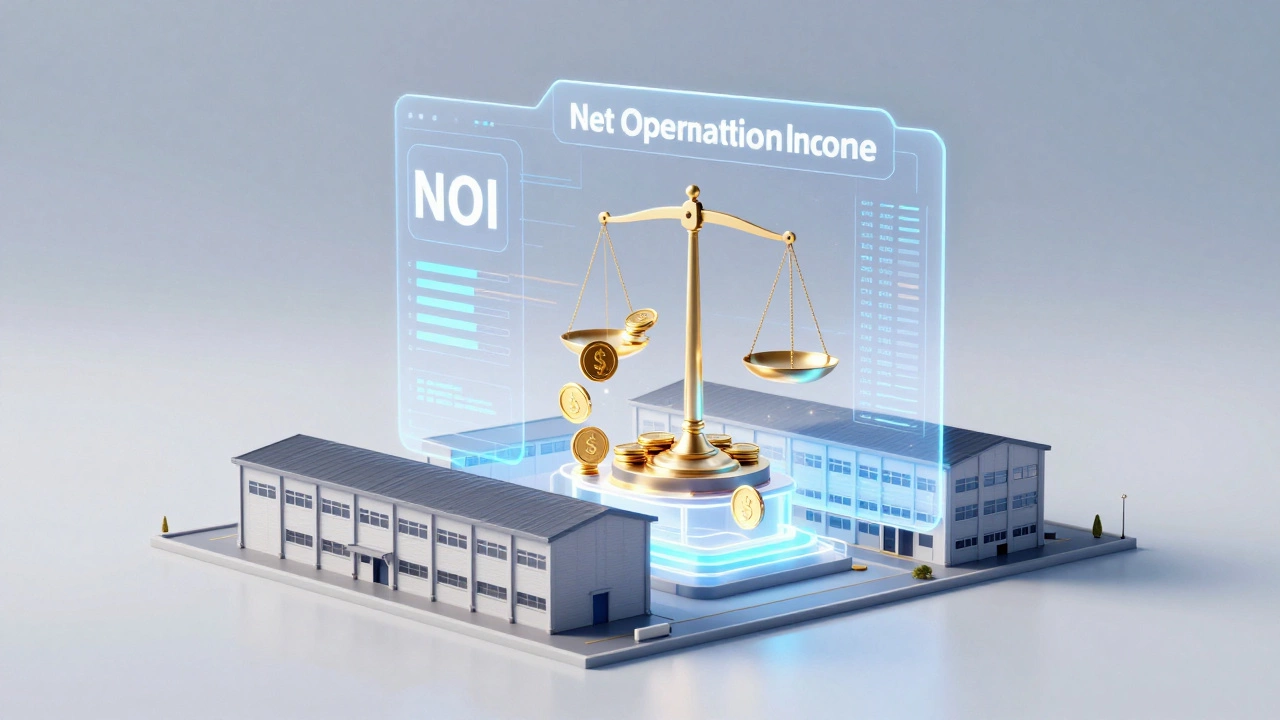
If you walk into a meeting with a broker and start talking about "monthly mortgage payments," they will look at you strangely. Professional investors talk in terms of Net Operating Income (NOI) and Capitalization Rate. These two metrics are the heartbeat of any commercial deal.
Net Operating Income (NOI) is the revenue generated by the property minus all operating expenses. Crucially, it does *not* include mortgage payments or income taxes. Why? Because every investor finances differently. By stripping away debt service, NOI gives you a pure view of the property’s performance. Think of it as the cash the building prints before you pay the bank.
Once you have the NOI, you use it to calculate the Cap Rate. The formula is simple: Cap Rate = NOI / Purchase Price. If a building costs $1 million and generates $50,000 in NOI, the cap rate is 5%. This percentage tells you the expected return on an all-cash purchase. In 2026, cap rates vary wildly by asset class. Industrial warehouses might trade at lower cap rates (4-5%) due to high demand, while older office buildings might sit at 7-8% because investors perceive them as riskier.
You use cap rates to compare apples to apples. If Building A offers a 4% return and Building B offers 6%, why would anyone buy A? Usually, it’s because Building A is in a prime location with a Fortune 500 tenant, making it safer. Higher cap rates mean higher risk. Understanding this trade-off is essential before you write a single check.
The Four Main Asset Classes
Not all commercial buildings are created equal. Each sector has its own drivers, risks, and reward profiles. Knowing which bucket fits your strategy is half the battle.
- Office: Once the king of CRE, office space has faced significant headwinds since the pandemic. Remote work is now permanent for many companies. Investing here requires extreme diligence. You want Class A buildings in dense urban cores with amenities that force people to come in. Older suburban offices are generally considered value traps unless they can be converted to mixed-use.
- Retail: The death of the shopping mall was exaggerated, but the shift is real. Successful retail investments today are anchored by essentials: grocery stores, medical clinics, and fitness centers. These are "destination" tenants that drive foot traffic. Avoid standalone shops selling discretionary items unless you have a unique demographic advantage.
- Industrial: This has been the hottest sector for the past decade. E-commerce relies on logistics. Warehouses, distribution centers, and flex spaces (half office, half warehouse) are in high demand. They tend to have shorter lease terms but lower vacancy rates. The key here is ceiling height (modern specs require 32+ feet) and truck accessibility.
- Multifamily: While technically residential in nature, apartment complexes with five or more units are treated as commercial investments. They offer diversification because you have dozens of tenants instead of one. If one person stops paying, the others keep the lights on. In 2026, affordability is driving demand toward smaller units and accessory dwelling units (ADUs).
Financing Your Deal: It’s Not a Mortgage
You won’t find a commercial loan application online with a "pre-approve" button. Commercial financing is bespoke. Banks and private lenders look at the property’s ability to repay the loan, not just your personal credit score. They use a metric called the Debt Service Coverage Ratio (DSCR).
Lenders want to see a DSCR of at least 1.25x. This means the property’s NOI must be 25% higher than the annual debt payment. If your annual mortgage payment is $100,000, the property needs to generate at least $125,000 in NOI. This buffer ensures that even if occupancy drops slightly, you can still service the debt.
Commercial loans also come with shorter terms. While a residential mortgage might stretch over 30 years, a commercial loan is often amortized over 20 or 30 years but has a balloon payment due in five to seven years. This means you’ll likely need to refinance or sell the property within that window. Planning for this exit strategy is part of the initial investment thesis.

The Due Diligence Checklist
Before you close, you need to verify everything. In residential deals, you get a home inspection. In commercial, you get a physical condition assessment, environmental review, title search, zoning verification, and lease audit. Skipping these steps is how investors lose millions.
- Physical Inspection: Hire a certified engineer to inspect the roof, HVAC, foundation, and electrical systems. Replacing a commercial roof can cost $200,000+. You need to know if that bill is coming due in six months or six years.
- Environmental Phase I: This report checks for contamination like asbestos, lead paint, or underground fuel tanks. If contamination is found, you could be liable for cleanup costs that exceed the property’s value. Most lenders require this anyway.
- Lease Audit: Don’t just trust the rent roll provided by the seller. Verify who is actually paying, when their lease expires, and what concessions were given (like free rent periods). Hidden liabilities in leases can destroy your projected NOI.
- Zoning and Land Use: Ensure the current use is permitted and that there are no pending zoning changes that could negatively impact the property. For example, a new highway route planned nearby could kill the value of a retail center.
Exit Strategies: How Do You Get Out?
Every investment needs an exit plan. You rarely hold commercial real estate forever. The most common exits are:
- Sale to Another Investor: This is the traditional path. You improve the property, increase rents, and sell at a higher cap rate compression.
- Refinancing: If the property’s value has increased, you can take out a new, larger loan and pull out your original capital plus profits. This allows you to recycle your money into new deals without selling.
- 1031 Exchange: This tax-deferred exchange allows you to sell one property and reinvest the proceeds into a "like-kind" property without paying capital gains taxes immediately. It’s a powerful tool for growing wealth over time, but the paperwork is strict and deadlines are tight.
How much money do I need to start investing in commercial real estate?
There is no single answer, but most institutional lenders require a minimum down payment of 20-30%. For a $1 million property, you’d need $200k-$300k in cash. However, you can enter the market with less by joining a syndication, where a sponsor pools money from multiple investors. Some syndications accept minimum investments as low as $25,000 or $50,000.
What is a Triple Net (NNN) lease?
A Triple Net lease is a common structure in retail and industrial real estate where the tenant pays not only the base rent but also all property expenses: property taxes, insurance, and maintenance. This makes NNN properties very attractive to passive investors because the landlord has minimal ongoing responsibilities and predictable cash flow.
Is commercial real estate better than residential?
It depends on your goals. Commercial real estate generally offers higher returns and less management hassle per unit (especially with NNN leases), but it requires more capital upfront and carries higher risk if a major tenant leaves. Residential real estate is more stable, easier to finance, and has a broader pool of potential buyers, making it easier to exit in a downturn.
How do I find commercial properties for sale?
Unlike residential listings, many commercial deals are off-market. You build relationships with commercial brokers who specialize in specific sectors (e.g., industrial or medical office). Online platforms like LoopNet and Crexi list public opportunities, but the best deals often come through direct networking with owners who are ready to sell but haven’t listed publicly yet.
What are the biggest risks in commercial real estate investing?
The primary risks are vacancy risk (losing a major tenant), interest rate risk (rising rates increase borrowing costs and lower property values), and economic downturns (recessions reduce business activity and rental income). Mitigation involves thorough due diligence, maintaining cash reserves, and diversifying across different property types and geographic locations.