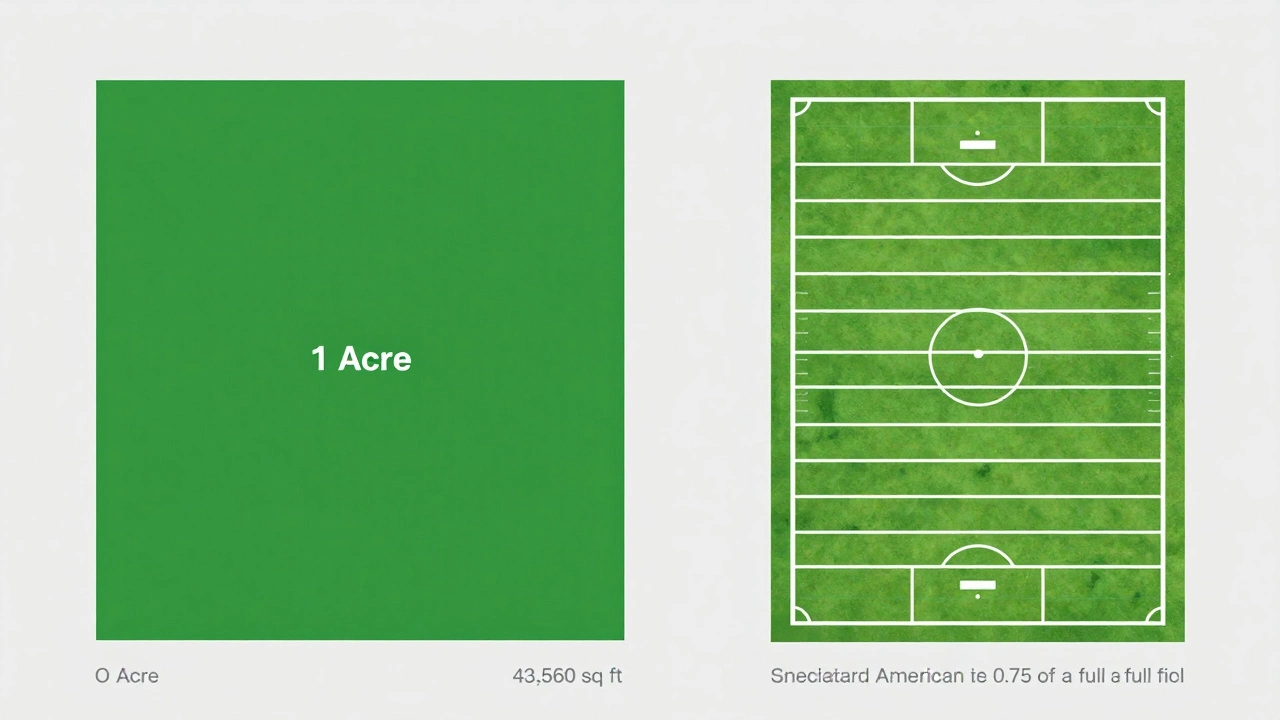
Land Size Visualizer & Calculator
| Unit | Value |
|---|---|
| Acres | 1.00 |
| Hectares | 0.40 |
| Square Feet | 43,560 |
| Roods | 4.00 |
| Sections | 0.00156 |
| American Football Fields | 0.76 |
| Soccer Pitches | 0.58 |
209' × 209'
Better Value
50' × 871'
Higher Costs
Why Shape Matters:
- Fencing costs can more than double on narrow lots due to longer perimeter
- Building setbacks consume a larger percentage of small or oddly-shaped lots
- Zoning requirements often mandate minimum frontage widths that narrow plots may not meet
- Maintenance costs increase with perimeter length (lawn care, snow removal, etc.)
Calculate Your Plot's Perimeter:
You’ve seen the listing: "2 acres of prime land." You nod along, but when you walk onto the property, it feels smaller than you imagined. Or maybe it feels huge. The problem is that numbers like "acre" or "hectare" are abstract. They sit in your head as units of measurement, not as physical spaces you can visualize.
This is where the football field analogy comes in. Most people have a pretty good sense of how big a football pitch is. It’s a standard reference point for large open spaces. So, let’s get straight to the answer: one acre is roughly equivalent to 0.75 American football fields (including the end zones). If you’re thinking about soccer pitches, one acre is about half a standard FIFA-sized field.
But why does this matter if you’re buying or selling land? Because understanding scale prevents expensive mistakes. Whether you’re planning a backyard garden, a small farm, or a commercial plot, knowing exactly what you’re looking at helps you budget for fencing, landscaping, and construction. Let’s break down the math, the variations, and how to use these comparisons to make smarter decisions about your next property purchase.
The Math Behind the Comparison
To understand the conversion, we need to look at the actual square footage. An acre is a standardized unit of area used primarily in the US customary and British imperial systems. One acre equals exactly 43,560 square feet. That number doesn’t change whether the land is a long, thin strip or a perfect square.
Now, let’s look at the football field. This is where things get tricky because "football" means different things depending on where you are in the world, and even within the same sport, dimensions vary by level of play.
| Field Type | Dimensions (Yards) | Square Feet | Acre Equivalent |
|---|---|---|---|
| American Football (NFL/College) + End Zones | 360 x 160 | 57,600 sq ft | 1.32 acres |
| American Football (Playing Field Only) | 300 x 160 | 48,000 sq ft | 1.10 acres |
| Soccer Pitch (FIFA Standard) | ~360 x ~245 | ~75,000 - 80,700 sq ft | ~1.7 - 1.85 acres |
| One Acre | Varies | 43,560 sq ft | 1.0 acre |
Here is the breakdown for American football, which is the most common reference in US real estate contexts:
- Full Field (with end zones): An NFL field is 360 feet long (including the two 10-yard end zones) and 160 feet wide. That totals 57,600 square feet. Since an acre is 43,560 square feet, one acre is approximately 0.756 of a full NFL field. Conversely, one full NFL field is about 1.32 acres.
- Playing Field Only (no end zones): If you only count the 100 yards of play, the area is 48,000 square feet. In this case, one acre is roughly 0.91 of the playing surface.
If you are in Europe, Asia, or South America, you likely think in terms of soccer (association football). A standard FIFA-regulated pitch is much larger, ranging from 70,000 to over 80,000 square feet. Therefore, one acre is significantly smaller-closer to half a soccer pitch.
Why Shape Matters More Than Square Footage
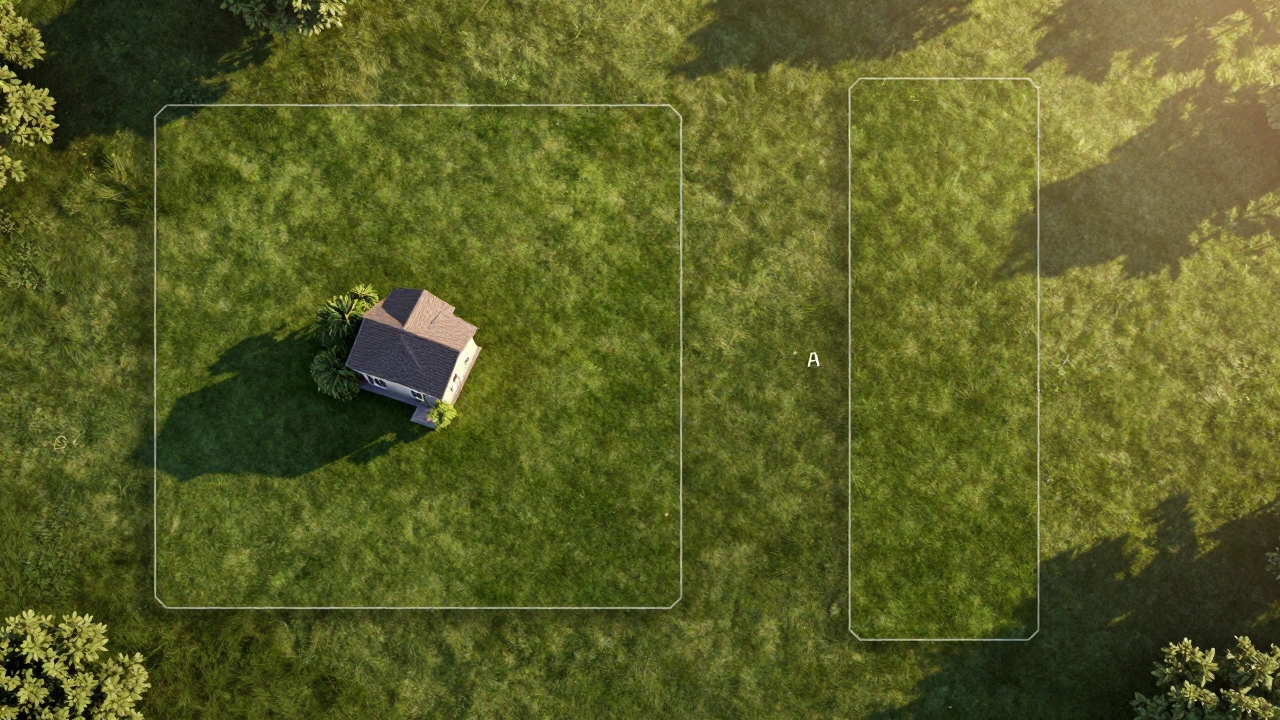
Knowing that an acre is 43,560 square feet is useful, but it doesn’t tell you the whole story. In real estate, shape dictates usability. Imagine two plots of land, both exactly one acre.
Plot A is a perfect square. Each side is approximately 208.7 feet long. This is highly usable. You can build a house in the center with yard space all around. Fencing costs are lower because the perimeter is shorter (about 835 feet).
Plot B is a long, narrow rectangle. It is 50 feet wide and 871.2 feet long. The area is identical, but the utility is completely different. You might struggle to fit a driveway. Building codes often require minimum frontage widths, so this plot might be unbuildable despite being the same size. The perimeter is much longer (over 1,842 feet), meaning your fencing and maintenance costs will more than double compared to Plot A.
When agents say "this lot is the size of a football field," they are usually simplifying. A football field has a fixed aspect ratio (roughly 2.25:1 including end zones). Most residential lots do not match this ratio. Always ask for the specific dimensions (width x depth) rather than relying solely on the acreage number.
Visualizing Land Sizes for Different Needs
Let’s apply this knowledge to common scenarios. How many football fields do you actually need?
The Suburban Backyard
Most suburban homes sit on lots between 0.15 and 0.25 acres. That’s about 6,500 to 10,000 square feet. To visualize this: it’s roughly one-quarter to one-third of an American football field. It’s enough space for a patio, a small garden, and room for kids to play, but don’t expect to run a full-length sprint.
The Family Farm or Large Estate
If you’re looking at 5 acres, you’re dealing with about 3.75 American football fields. This is significant space. You could potentially subdivide this into two large residential lots, or keep it as one expansive property with room for a guest house, a large pool, and extensive landscaping. At this size, topography becomes critical. Five acres of flat land is worth far more for development than five acres of steep hillside.
Agricultural Use
For farming, the football field analogy breaks down slightly because farmers think in terms of rows and yield. However, it still helps with equipment logistics. A standard tractor implement might cover a certain width per pass. Knowing that 10 acres is roughly 7.5 football fields helps you estimate labor hours. If it takes an hour to mow a quarter-acre park, it will take four hours to mow one acre.
Common Pitfalls When Estimating Land Value
Buyers often fall into the trap of comparing price per acre without considering the "effective" acreage. Here are three factors that change the value of those 43,560 square feet:
- Setbacks and Easements: Local zoning laws may require you to set back 25 feet from the road and 10 feet from property lines. On a small lot, this "non-buildable" buffer can consume 20% of your land. On a large lot, it’s negligible. Always check the survey map for easements (rights of way for utilities or neighbors) that reduce your usable area.
- Topography: One acre of flat, cleared land is easier to develop than one acre of dense forest or rocky terrain. Clearing costs can range from $1,000 to $5,000 per acre. If the land slopes heavily, you’ll need retaining walls or terracing, which adds thousands more. The "football field" is only valuable if you can actually stand on it comfortably.
- Zoning Restrictions: Just because you have the space for a building doesn’t mean you’re allowed to put it there. Agricultural zoning might prohibit residential construction. Check the local zoning code before assuming that 2 acres means you can build two houses.
Converting to Other Units
While the football field is a great mental model, you’ll encounter other units in listings. Here is how an acre stacks up against them:
- Hectares: Common in metric countries. One hectare is 10,000 square meters, which equals about 2.47 acres. So, a 1-hectare plot is roughly 1.85 American football fields.
- Roods: An older unit, mostly found in historical documents or UK land records. One rood is 1/4 of an acre. Four roods equal one acre.
- Sections: Used in public land surveys in the US. One section is 640 acres. That’s nearly 500 football fields. This is typical for large ranches or government land sales.
When negotiating, stick to one unit to avoid confusion. If a seller quotes price per hectare and you’re thinking in acres, convert everything to square feet first to ensure you’re comparing apples to apples.
Next Steps for Your Land Search
Before you sign any offer, take these steps to verify the land’s true value:
- Get the Survey: Don’t rely on the agent’s description. Request a recent plat map or survey that shows exact dimensions, boundaries, and any encroachments.
- Walk the Property: Bring a tape measure. Walk the perimeter. Does it feel like the dimensions suggest? Look for hidden obstacles like streams, rock outcroppings, or power lines.
- Check Zoning Online: Most county assessor websites allow you to look up zoning codes by address or parcel ID. Verify what structures are permitted.
- Calculate Development Costs: Add up the cost of clearing, grading, fencing, and bringing utilities (water, sewer, electric) to the site. These costs can sometimes exceed the land price itself for remote parcels.
Understanding that one acre is roughly three-quarters of a football field gives you a solid baseline. But remember, land is unique. Two acres of flat, zoned-for-residential land near a highway are worth infinitely more than two acres of steep, agricultural land in a remote valley. Use the size comparison as a starting point, then dig into the specifics of usability and regulation.
Is an acre bigger than a football field?
It depends on which football field you mean. An acre (43,560 sq ft) is smaller than a full American football field including end zones (57,600 sq ft). However, an acre is larger than just the playing field without end zones (48,000 sq ft). For soccer, an acre is significantly smaller than a standard FIFA pitch.
How many acres is a standard high school football field?
A standard high school football field, including the end zones, is typically the same size as an NFL field: 360 feet long by 160 feet wide. This equals 57,600 square feet, which is approximately 1.32 acres.
What is the square footage of 1 acre?
One acre is exactly 43,560 square feet. This is a fixed definition used in the US customary and British imperial systems of measurement.
How do I visualize 5 acres of land?
Five acres is equal to 217,800 square feet. Visually, this is roughly equivalent to 3.75 American football fields (including end zones). It is a substantial amount of land, often enough for a large home, multiple outbuildings, and significant yard space.
Does the shape of an acre affect its value?
Yes, significantly. A square-shaped acre is more valuable for building purposes than a long, narrow acre because it offers better usability, lower fencing costs, and easier compliance with setback regulations. Always check the specific dimensions (width and depth) rather than just the total acreage.
How many soccer pitches fit in one acre?
A standard FIFA-regulated soccer pitch ranges from 70,000 to 80,700 square feet. Therefore, one acre (43,560 sq ft) is approximately half the size of a standard soccer pitch.
What is the difference between an acre and a hectare?
An acre is a unit used in the US and UK, while a hectare is part of the metric system. One hectare is equal to 10,000 square meters, which converts to approximately 2.47 acres. So, a hectare is larger than an acre.