Acre Size & Shape Visualizer
Visual Context
How does your plot compare to familiar objects?
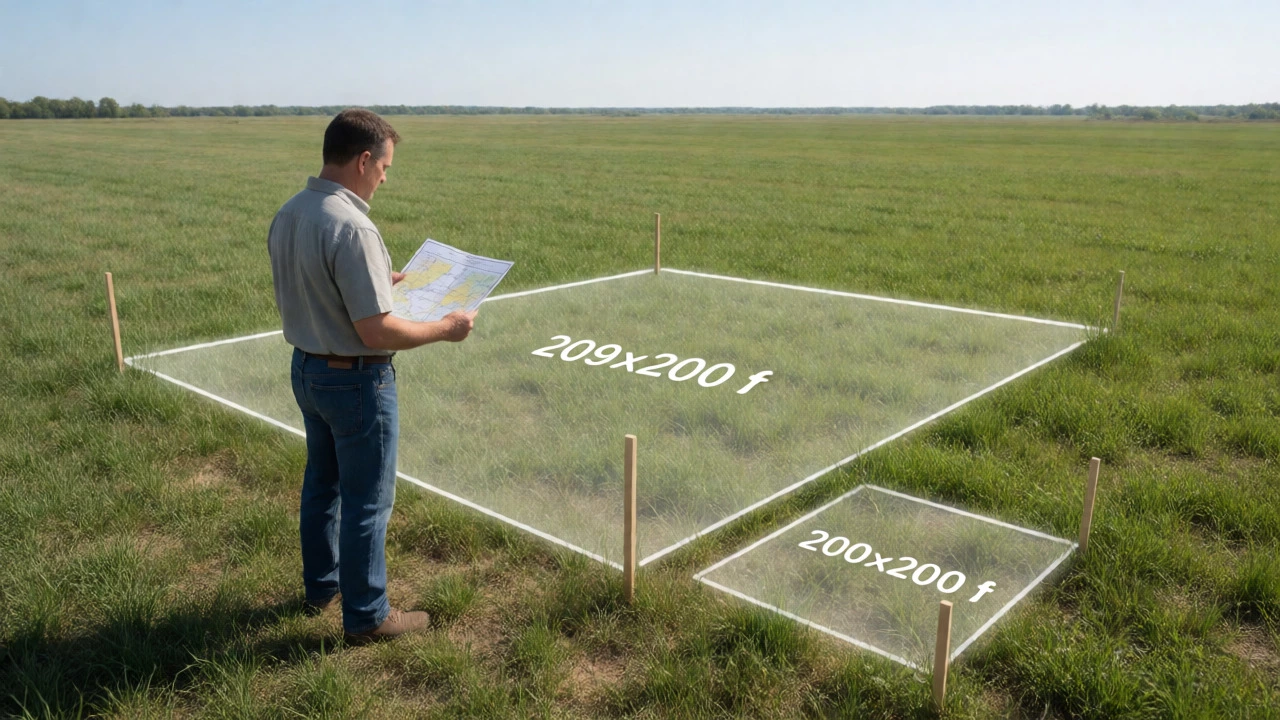
You are standing in a field, looking at a plot of land listed as "1 acre." You pull out your tape measure or look at the survey map. Does it feel like 200 feet by 200 feet? It feels close, right? But if you do the math, something is off. An acre is not a square with equal sides. In fact, assuming an acre is 200 feet by 200 feet leads to a significant error that could cost you money or space when you are trying to build.
This confusion is incredibly common among first-time land buyers and even seasoned investors who rely on quick mental estimates. The idea that an acre is a perfect square comes from rounding numbers for simplicity. But land does not care about our desire for easy math. If you are planning a subdivision, a garden, or a commercial facility, getting the dimensions wrong can mean zoning violations or wasted budget. Let’s clear up the geometry of an acre so you never have to guess again.
The Exact Math Behind an Acre
To understand why 200x200 is incorrect, we need to look at what an acre actually is. It is a unit of area, not length. Specifically, one acre equals exactly 43,560 square feet. This number comes from historical agricultural measurements, but today it is the standard for real estate transactions across the United States and many other countries using imperial units.
If you multiply 200 feet by 200 feet, you get 40,000 square feet. That means a 200x200 plot is roughly 8% smaller than a true acre. In the world of high-stakes real estate, missing 3,560 square feet is substantial. That is enough space for a decent-sized garage, a small workshop, or several parking spots. When you pay per square foot or per acre, this discrepancy matters.
So, what are the actual dimensions of a square acre? To find the side length of a square with an area of 43,560 square feet, you take the square root of that number. The result is approximately 208.71 feet. So, a perfectly square acre is roughly 209 feet by 209 feet. Rounding down to 200 feet saves time in casual conversation, but it fails in construction planning.
Acre vs. Football Field: A Better Visual
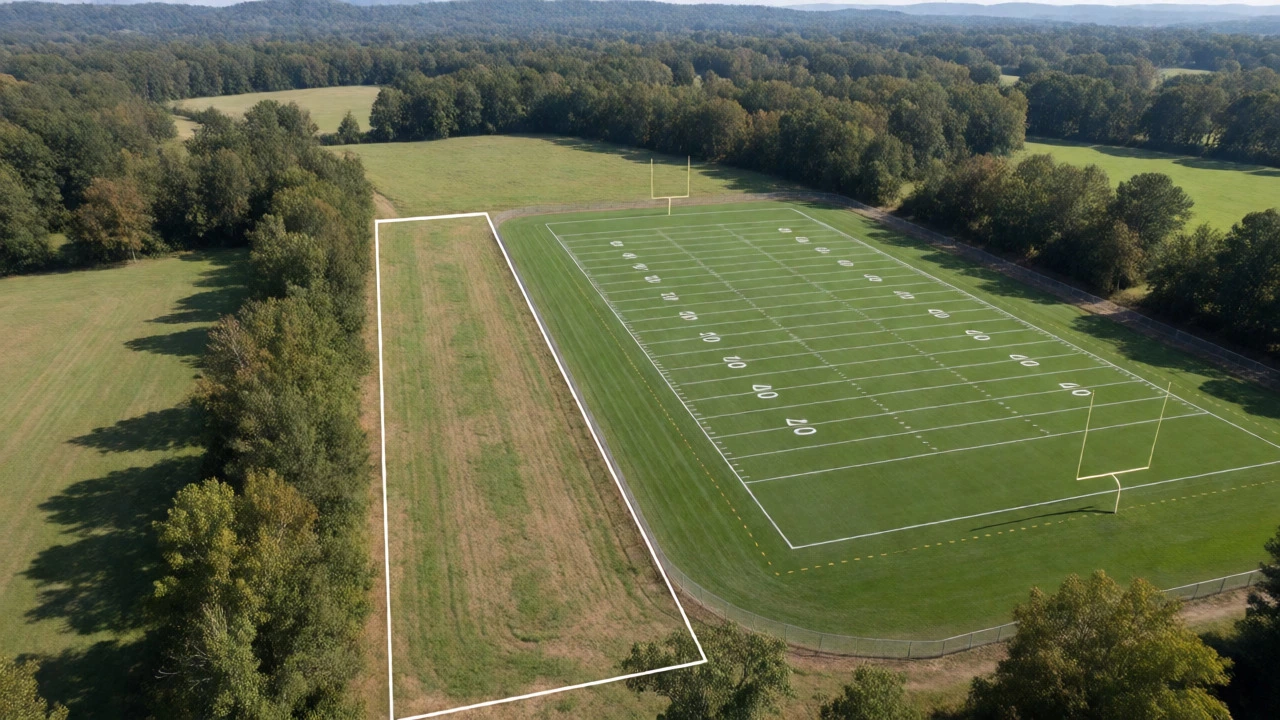
People struggle to visualize 43,560 square feet because it is too large to see all at once. We need reference points. You might hear people compare an acre to a football field. This is a helpful analogy, but it needs correction. A standard American football field (including end zones) is 120 yards long by 53.3 yards wide. Converted to feet, that is 360 feet by 160 feet, which equals 57,600 square feet.
This means a football field is actually larger than an acre. One acre is only about 75% of a football field. If you walk the length of a football field, you cover 360 feet. To make an acre out of that strip, you would only need a width of about 121 feet (since 360 x 121 ≈ 43,560). This "long and thin" shape is how many rural roadsides are laid out, but it surprises people who expect a compact block.
| Reference Object | Approximate Area (sq ft) | Comparison to 1 Acre |
|---|---|---|
| Standard Football Field | 57,600 | Larger (1.32 acres) |
| Tennis Court | 7,840 | Smaller (0.18 acres) |
| Baseball Diamond (Infield) | ~4,000 | Smaller (0.09 acres) |
| Square Acre Side Length | N/A (Length) | 208.71 feet |
Why Shape Matters More Than Size
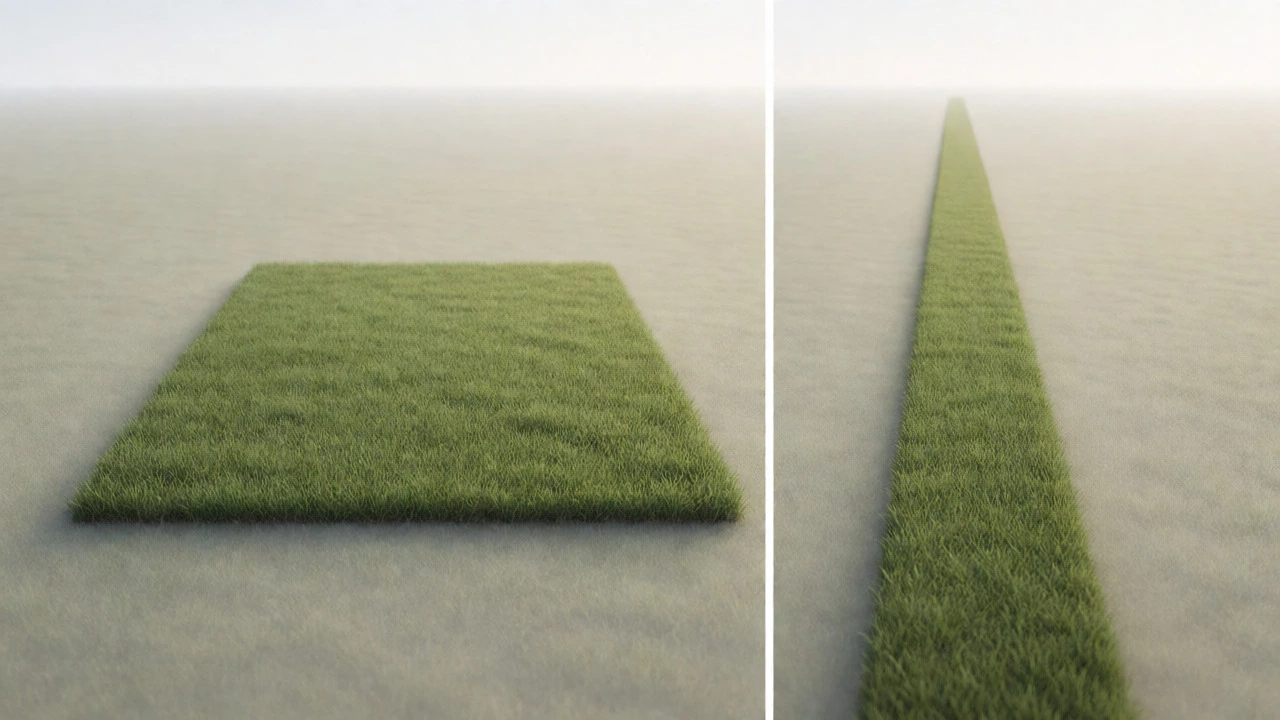
Here is the critical part most buyers miss: an acre can be any shape. It doesn’t have to be a square. It could be a rectangle, a triangle, an L-shape, or an irregular polygon. As long as the total area sums to 43,560 square feet, it is an acre.
Consider two plots, both exactly one acre:
- Plot A: A square measuring 209 feet by 209 feet.
- Plot B: A narrow strip measuring 10 feet by 4,356 feet.
Both are acres. But Plot B is practically useless for building a house unless you want a very unusual layout. It has almost no frontage relative to its depth and likely violates minimum setback requirements for most municipalities. Conversely, Plot A offers balanced access from multiple sides and easier utility routing.
When you buy land, you aren't just buying area; you are buying usability. Two acres of steep, rocky terrain might hold less value than one acre of flat, serviced land. Always check the topography and shape before falling in love with the acreage count.
Metric Conversions for Global Context
If you live outside the US or Canada, or if you deal with international developers, you might encounter hectares instead of acres. This is where things get confusing for those who mix systems casually.
One hectare equals 10,000 square meters. In square feet, that is approximately 107,639 square feet. Therefore, one hectare is roughly 2.47 acres. If a property listing says "5 hectares," do not assume it is slightly more than 5 acres. It is nearly 12.5 acres. Misreading these units can lead to massive budget errors.
For those in Australia or Europe, visualizing in meters helps. Since 1 foot is 0.3048 meters, a square acre is roughly 63.6 meters by 63.6 meters. If you are used to metric thinking, picture a square roughly the size of a large city block or a medium-sized supermarket footprint. That is your acre.
Practical Tips for Verifying Land Size
Never rely solely on the seller's claim that "it's about an acre." Here is how to verify the reality on the ground.
- Request a Survey Plat: This is a legal document showing exact boundaries and dimensions. Look for the total area calculation in square feet or acres. Do not trust hand-drawn sketches.
- Use Satellite Imagery Tools: Apps like Google Earth Pro allow you to draw polygons over land parcels. The tool calculates the area automatically. While not legally binding, it gives you a quick sanity check. Draw a box around the property and see if the reported area matches the listing.
- Check Zoning Minimums: Some areas require a minimum lot size for single-family homes. If the zoning requires a minimum of 1 acre, and the lot is 0.98 acres, you might not be able to build. Even if it looks big enough, the legal definition rules.
- Walk the Perimeter: If possible, physically walk the boundary lines. Pace them out. An average walking pace is about 2-3 feet per step. If the side takes you 70 steps, that is roughly 140-210 feet. Compare this to the expected 209 feet for a square acre. Discrepancies here flag potential encroachment issues.
The Cost Implication of Miscalculation
Let’s say you are buying land at $10 per square foot. If you think you are getting 40,000 square feet (the 200x200 myth) but actually get 43,560 square feet, you are paying for 3,560 extra square feet. At $10/sq ft, that is an extra $35,600. Conversely, if you are selling and use the 200x200 estimate to price your land, you might undervalue it by thousands.
In rural markets, land is often sold by the acre rather than by the square foot. However, improvements like fencing, grading, and driveway installation are calculated by linear feet or square footage. If you underestimate the perimeter of your acre (which varies wildly by shape), you will blow your fencing budget. A square acre has a perimeter of roughly 835 feet. A rectangular acre that is 100 feet wide and 435 feet deep has a perimeter of 1,070 feet. Fencing that extra 235 feet costs real money.
Is an acre always square?
No, an acre is a unit of area, not shape. It can be any shape-square, rectangular, circular, or irregular-as long as the total area equals 43,560 square feet. Most natural land parcels are irregular due to geographical features and existing boundaries.
How many square feet are in an acre?
There are exactly 43,560 square feet in one acre. This is a fixed conversion used universally in the United States customary system for land measurement.
What are the dimensions of a square acre?
A perfect square acre measures approximately 208.71 feet on each side. Many people round this to 209 feet for practical estimation purposes.
Is an acre bigger than a football field?
No, a standard American football field including end zones is larger than an acre. A football field is about 57,600 square feet, while an acre is 43,560 square feet. An acre is roughly 75% of a football field.
How do I convert acres to hectares?
To convert acres to hectares, divide the number of acres by 2.471. Alternatively, multiply the acres by 0.4047. For example, 10 acres is approximately 4.047 hectares.